publications
publications by categories in reversed chronological order. generated by jekyll-scholar.
2026
- SynGallery: A Synthetic Gallery of Real Paintings for Instance-Level Artwork RecognitionPatryk Bartkowiak, Jakub Markil, Bartosz Kotrys, and 3 more authorsVISART @ ECCV 2026
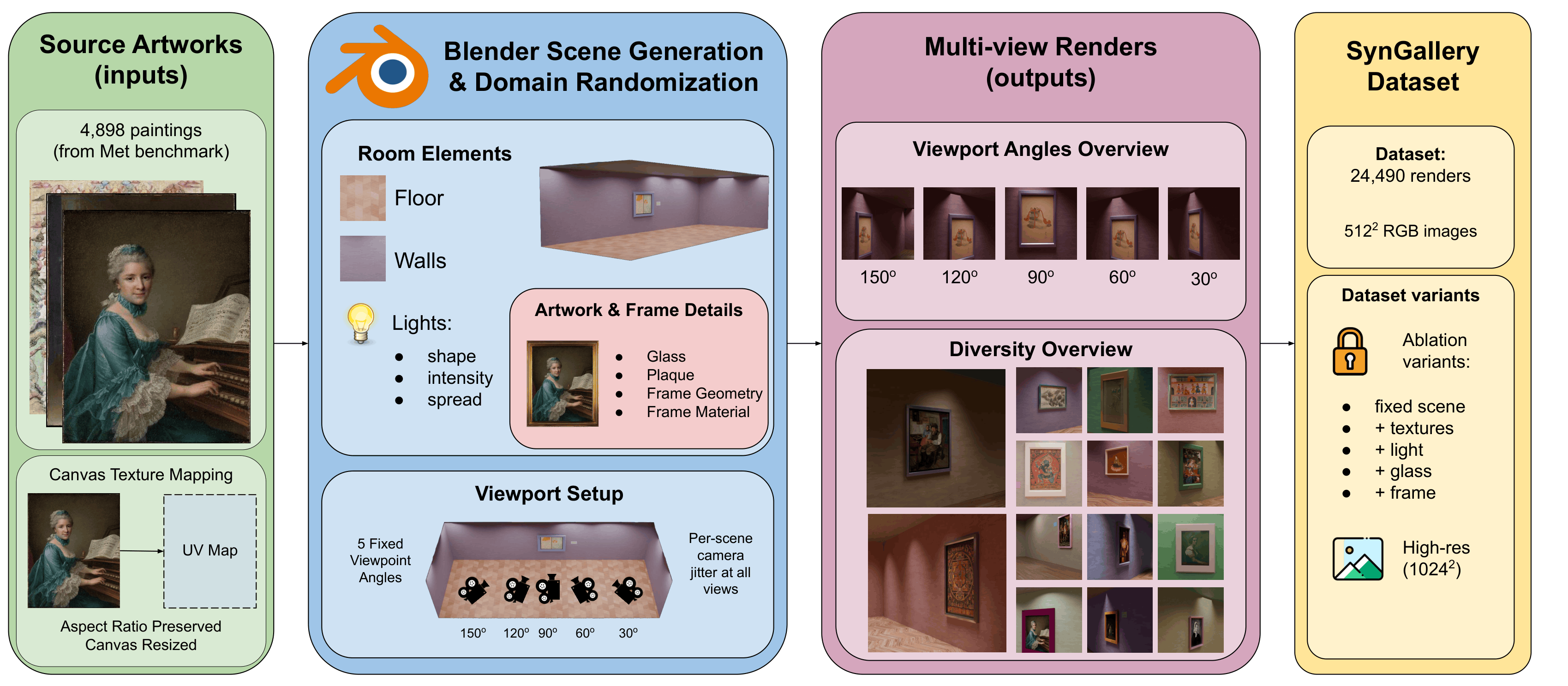
Instance-level artwork recognition requires matching a handheld visitor photograph to a specific work in a large museum collection. This is difficult because museum datasets typically provide clean catalog images for training, while test queries are captured under oblique viewpoints, gallery lighting, reflections, frames, and other scene-level variations. We present SynGallery, a synthetic gallery dataset for artwork retrieval that addresses this gap without collecting additional visitor photographs. Starting from catalog images of real paintings, we place each artwork into a procedurally generated 3D gallery scene and render it from multiple viewpoints under varied geometric and appearance conditions, while preserving the exact identity of the original work. The resulting dataset contains 24,490 rendered views of 4,898 paintings from the Met benchmark. We show that these synthetic views provide a stronger training signal than the corresponding studio photographs. At a matched image budget, training only on SynGallery improves closed-world painting recognition from 67.18 to 73.47 GAP-. When added to the full Met training set, SynGallery improves the published benchmark protocol from 35.97 to 38.48 GAP, without changing the retrieval architecture or adding real visitor photos. Ablations show that the gain comes primarily from geometric viewpoint variation rather than low-level photographic realism: simulated blur, sensor noise, and compression consistently reduce performance.
@inproceedings{bartkowiak2026syngallery, title = {SynGallery: A Synthetic Gallery of Real Paintings for Instance-Level Artwork Recognition}, author = {Bartkowiak, Patryk and Markil, Jakub and Kotrys, Bartosz and Michels, Dominik L. and Pirk, S{\"o}ren and Palubicki, Wojtek}, booktitle = {Vision for Art and Culture (VISART VIII) Workshop at the European Conference on Computer Vision}, month = sep, year = {2026}, address = {Malm{\"o}, Sweden}, } - EdgeWisePersona: A Dataset for On-Device User Profiling from Natural Language InteractionsPatryk Bartkowiak and Michal PodstawskiUMAP 2026
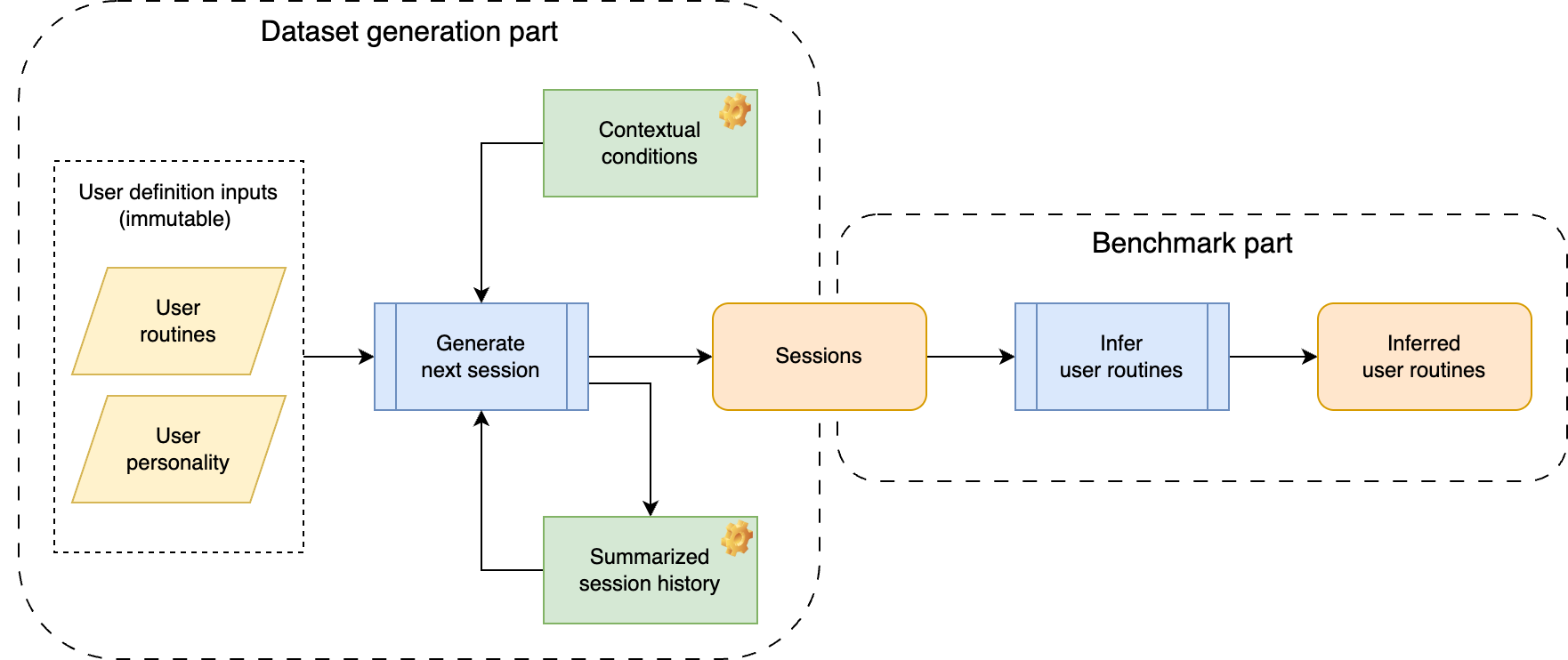
This paper introduces EdgeWisePersona, a novel dataset and evaluation benchmark for assessing and improving small, edge-deployable language models for user profiling from multi-session smart home interactions. The dataset features structured user profiles defined by contextual routines, paired with natural language dialogues. The primary task is profile reconstruction: inferring user routines and preferences solely from interaction history. To assess how well current models can perform this task under realistic conditions, we benchmarked several state-of-the-art compact language models and compared their performance against large foundation models. Our results show that while small models demonstrate some capability in reconstructing profiles, they still fall significantly short of large models in accurately capturing user behavior. This performance gap poses a major challenge - particularly because on-device processing offers critical advantages, such as preserving user privacy, minimizing latency, and enabling personalized experiences without reliance on the cloud. By providing a realistic, structured testbed for developing and evaluating behavioral modeling under these constraints, our dataset represents a key step toward enabling intelligent, privacy-respecting AI systems that learn and adapt directly on user-owned devices.
@inproceedings{10.1145/3774935.3806788,
  author = {Bartkowiak, Patryk and Podstawski, Michal},
  title = {EdgeWisePersona: A Dataset for On-Device User Profiling from Natural Language Interactions},
  year = {2026},
  isbn = {9798400723117},
  publisher = {Association for Computing Machinery},
  address = {New York, NY, USA},
  url = {https://doi.org/10.1145/3774935.3806788},
  doi = {10.1145/3774935.3806788},
  booktitle = {Proceedings of the 34th ACM Conference on User Modeling, Adaptation and Personalization},
  pages = {361--365},
  numpages = {5},
  keywords = {on-device AI, user profiling, personalization, dialogue data, privacy-preserving ML},
  location = {Gothenburg, Sweden},
  series = {UMAP '26},
}
2025
- Exploring the Cognitive Capabilities of Large Language Models in Autonomous and Swarm Navigation SystemsDawid Ewald, Filip Rogowski, Marek Suśniak, and 2 more authorsElectronics 15, 2025
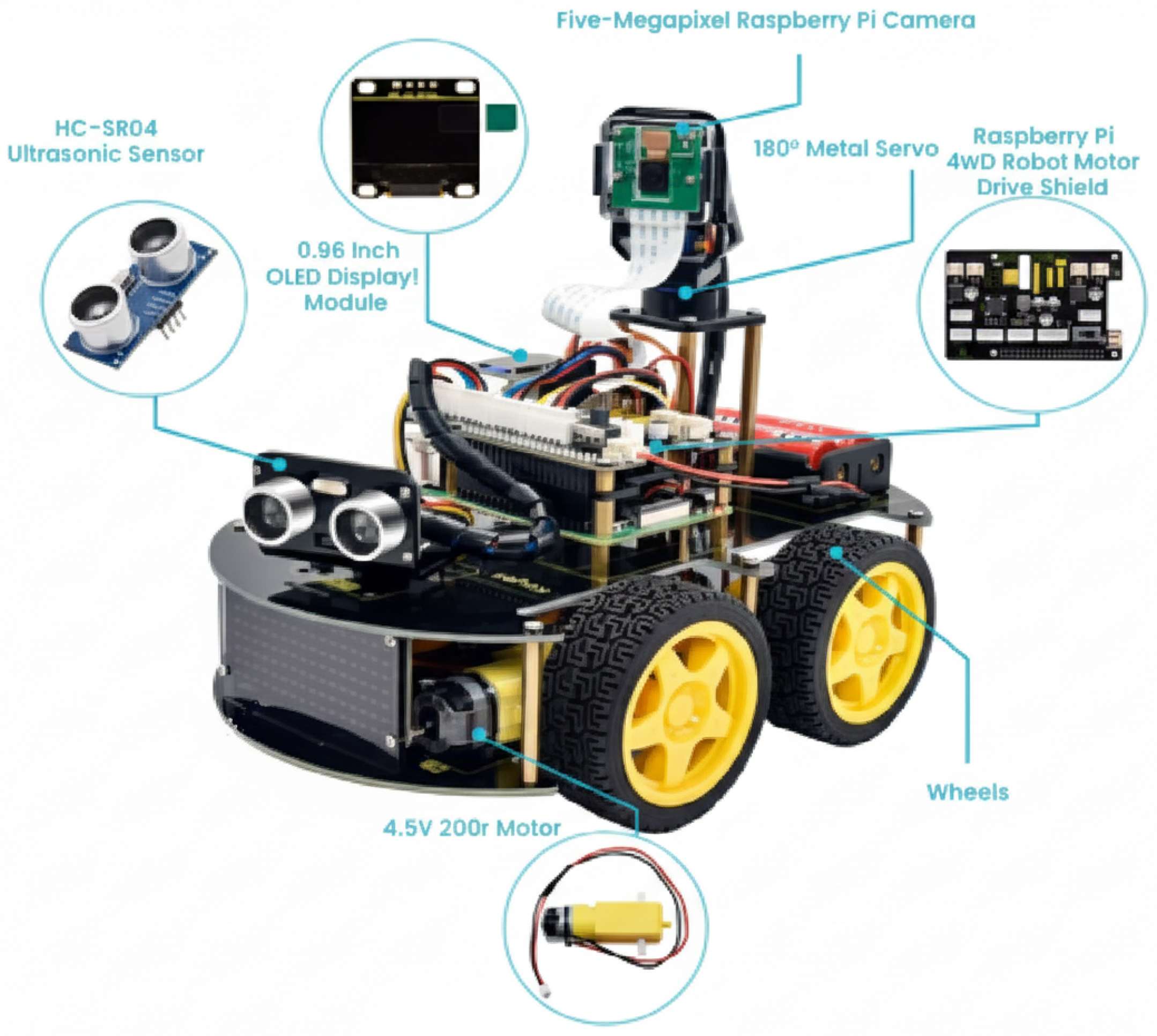
The rapid evolution of autonomous vehicles necessitates increasingly sophisticated cognitive capabilities to handle complex, unstructured environments. This study explores the cognitive potential of Large Language Models (LLMs) in autonomous navigation and swarm control systems, addressing the limitations of traditional rule-based approaches. The research investigates whether multimodal LLMs, specifically a customized version of LLaVA 7B (Large Language and Vision Assistant), can serve as a central decision-making unit for autonomous vehicles equipped with cameras and distance sensors. The developed prototype integrates a Raspberry Pi module for data acquisition and motor control with a main computational unit running the LLM via the Ollama platform. Communication between modules combines REST API for sensory data transfer and TCP sockets for real-time command exchange. Without fine-tuning, the system relies on advanced prompt engineering and context management to ensure consistent reasoning and structured JSON-based control outputs. Experimental results demonstrate that the model can interpret real-time visual and distance data to generate reliable driving commands and descriptive situational reasoning. These findings suggest that LLMs possess emerging cognitive abilities applicable to real-world robotic navigation and lay the groundwork for future swarm systems capable of cooperative exploration and decision-making in dynamic environments. These insights are particularly valuable for researchers in swarm robotics and developers of edge-AI systems seeking efficient, multimodal navigation solutions.
@article{ewald2025exploring, title = {Exploring the Cognitive Capabilities of Large Language Models in Autonomous and Swarm Navigation Systems}, author = {Ewald, Dawid and Rogowski, Filip and Su{\'s}niak, Marek and Bartkowiak, Patryk and Blumensztajn, Patryk}, journal = {Electronics}, volume = {15}, number = {1}, pages = {35}, month = dec, year = {2025}, publisher = {MDPI}, doi = {10.3390/electronics15010035}, url = {https://doi.org/10.3390/electronics15010035}, } - Seamlessly Integrating Tree-Based Positional Embeddings into Transformer Models for Source Code RepresentationPatryk Bartkowiak and Filip GralińskiXLLM @ ACL 2025
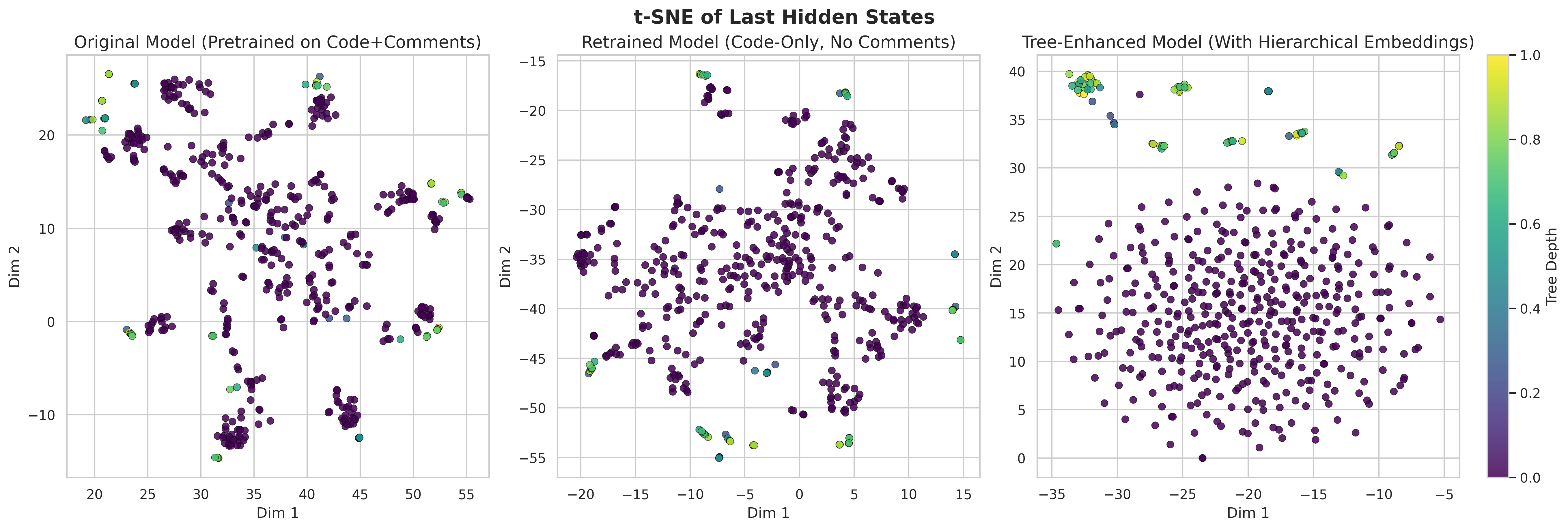
Transformer-based models have demonstrated significant success in various source code representation tasks. Nonetheless, traditional positional embeddings employed by these models inadequately capture the hierarchical structure intrinsic to source code, typically represented as Abstract Syntax Trees (ASTs). To address this, we propose a novel tree-based positional embedding approach that explicitly encodes hierarchical relationships derived from ASTs, including node depth and sibling indices. These hierarchical embeddings are integrated into the transformer architecture, specifically enhancing the CodeBERTa model. We thoroughly evaluate our proposed model through masked language modeling (MLM) pretraining and clone detection fine-tuning tasks. Experimental results indicate that our Tree-Enhanced CodeBERTa consistently surpasses the baseline model in terms of loss, accuracy, F1 score, precision, and recall, emphasizing the importance of incorporating explicit structural information into transformer-based representations of source code.
@inproceedings{bartkowiak-gralinski-2025-seamlessly,
  title = {Seamlessly Integrating Tree-Based Positional Embeddings into Transformer Models for Source Code Representation},
  author = {Bartkowiak, Patryk and Grali{\'n}ski, Filip},
  booktitle = {Proceedings of the 1st Joint Workshop on Large Language Models and Structure Modeling (XLLM 2025)},
  month = aug,
  year = {2025},
  address = {Vienna, Austria},
  publisher = {Association for Computational Linguistics},
  url = {https://aclanthology.org/2025.xllm-1.10/},
  doi = {10.18653/v1/2025.xllm-1.10},
  pages = {91--98},
  isbn = {979-8-89176-286-2},
}